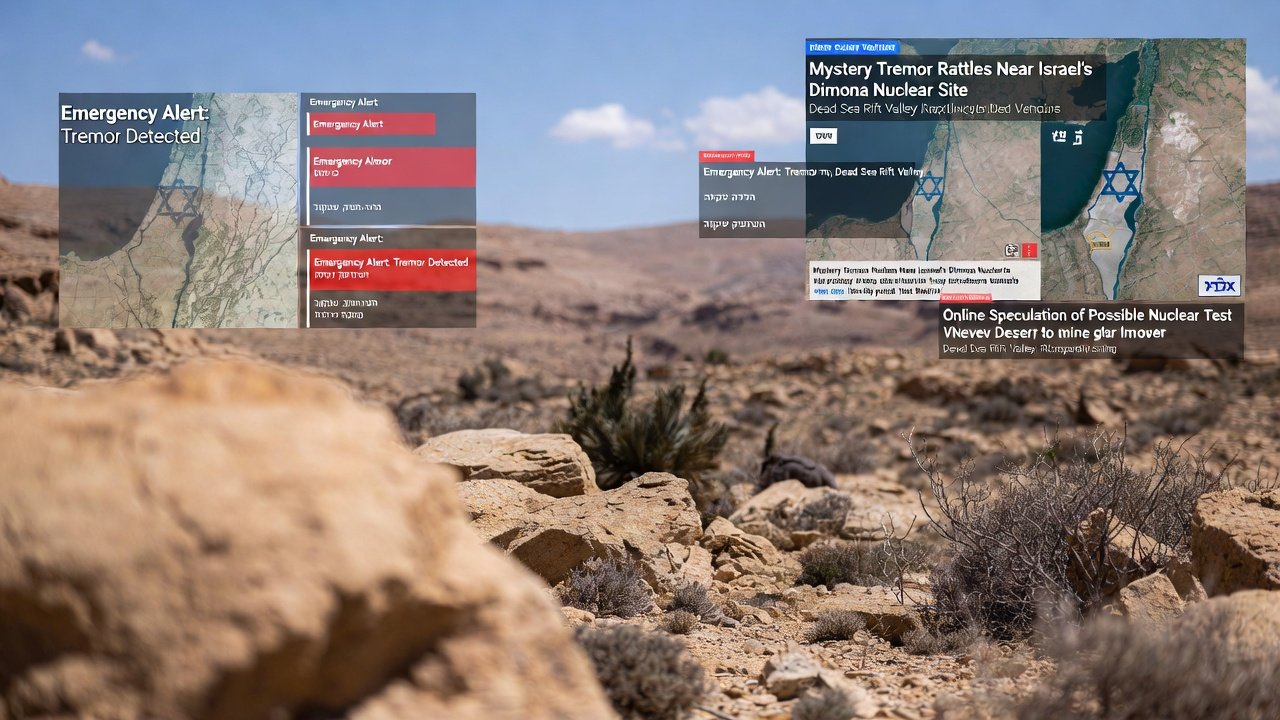
January 16, 2026 – A moderate 4.2-magnitude earthquake struck southern Israel’s Negev Desert early Thursday morning, with its epicenter located just kilometers from the highly secretive Shimon Peres Negev Nuclear Research Center near Dimona. The tremor, which lasted only about 1.5 seconds and was felt across the Dead Sea region and parts of central Israel, triggered emergency alerts and set off a wave of online speculation about whether the seismic activity could indicate an underground nuclear test rather than a natural event.
According to data from the European-Mediterranean Seismological Centre (EMSC) and Israel’s Geological Survey, the shallow quake (at approximately 10 km depth) occurred around 9:00 a.m. local time, coinciding precisely with a pre-scheduled nationwide emergency preparedness drill in schools. No injuries or significant structural damage were reported by Magen David Adom or local authorities, who described the event as consistent with the region’s occasional mild to moderate seismic activity along the Dead Sea Rift Valley fault system.
The proximity to Dimona—the site long associated with Israel’s undeclared nuclear program—immediately fueled conspiracy theories and intense social media debate. Posts on platforms like X (formerly Twitter) surged, with users questioning if the short, sharp nature of the tremor matched signatures sometimes linked to controlled underground explosions. Some commentators drew parallels to past seismic events in other nuclear-capable nations, while others suggested the timing could serve as a subtle strategic signal amid escalating friction with Iran and uncertainty over potential U.S. involvement in the region.
The speculation gained traction as the quake unfolded against a backdrop of severe domestic unrest in Iran, where protests against the regime have led to thousands of reported casualties and threats of retaliation against U.S. and allied interests. U.S. President Donald Trump has issued strong warnings regarding Iran’s leadership, while Israeli officials have maintained a posture of readiness in the face of perceived threats from Tehran and its proxies.
Official sources in Israel have not commented directly on the nuclear test rumors, with seismic experts emphasizing that the area’s geology frequently produces similar events unrelated to human activity. The Dead Sea Transform fault, a major tectonic boundary, regularly generates quakes of this magnitude, and Thursday’s tremor aligns with historical patterns in the Negev.
Nevertheless, the incident has amplified concerns in an already volatile Middle East. Online discussions highlight fears that any perceived escalation—whether natural or otherwise—could influence diplomatic calculations, military postures, or deterrence strategies involving nuclear capabilities.
As monitoring agencies continue to analyze data, the event serves as a reminder of how quickly seismic phenomena in sensitive locations can intersect with geopolitics, sparking debate far beyond the immediate epicenter. While most evidence points to a routine natural occurrence, the combination of location, timing, and current tensions ensures the speculation will persist in the days ahead. International observers and seismologists will likely provide further clarification as more detailed reports emerge.