
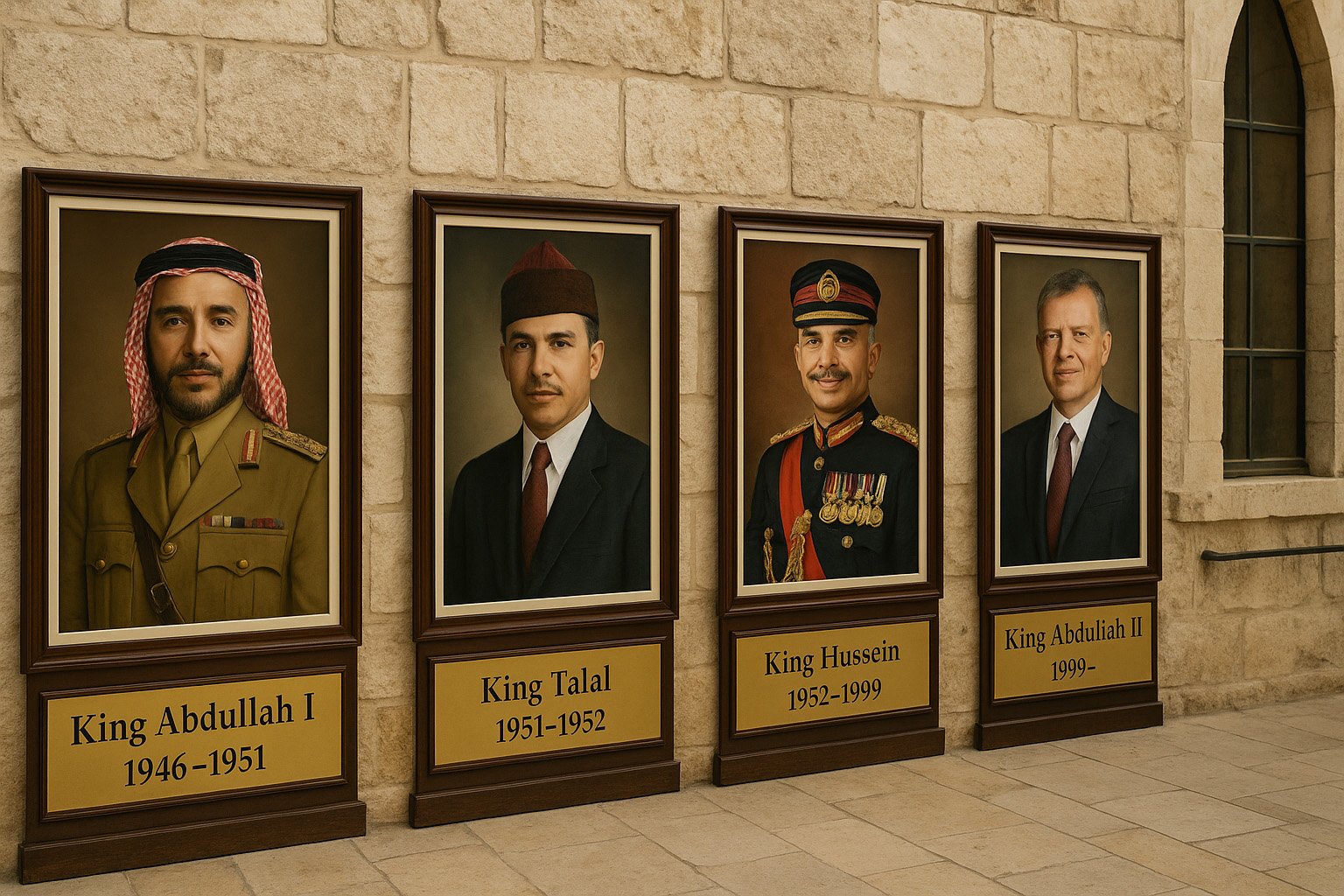
History of the Kings of Jordan: The Hashemite Legacy
Jordan, officially the Hashemite Kingdom of Jordan, is one of the most stable monarchies in the Arab world. The royal family, descended from the Hashemite lineage of the Prophet Muhammad, has played a pivotal role in shaping the modern Middle East. The monarchy has guided Jordan through wars, regional tensions, economic challenges, and peace efforts, maintaining a central role in both Arab and global politics.
King Abdullah I (1946–1951) – The Founder
Abdullah I bin Al-Hussein was the first king of Jordan. A key figure in the Arab Revolt against the Ottoman Empire during World War I, he later became the Emir of Transjordan under British mandate in 1921.
In 1946, when Jordan gained independence, he was declared King of the Hashemite Kingdom of Jordan. Abdullah I played a major role in shaping Jordan’s borders and governance. He annexed the West Bank after the 1948 Arab-Israeli War but was assassinated in 1951 while entering Al-Aqsa Mosque in Jerusalem.
King Talal (1951–1952) – The Short Reign
King Talal, son of Abdullah I, ruled for just over a year before being forced to abdicate due to health issues. Despite his brief rule, he is remembered for establishing Jordan’s first modern constitution in 1952, which laid the groundwork for a constitutional monarchy.
King Hussein (1952–1999) – The Statesman King
King Hussein bin Talal, one of the most prominent Middle Eastern leaders of the 20th century, ascended the throne at age 16. His reign lasted nearly five decades and was marked by:
- Surviving multiple assassination attempts and military coups
- Navigating Jordan through the 1956 Suez Crisis, 1967 Six-Day War (which resulted in the loss of the West Bank), and Black September conflict with Palestinian factions in 1970
- Making peace with Israel in 1994, the second Arab country to do so
- Balancing relations with Western powers and Arab neighbors during shifting alliances
King Hussein was widely respected for his diplomacy, resilience, and moderation, and he ensured that Jordan remained a relatively stable and progressive nation.
King Abdullah II (1999–Present) – A Modernizing Monarch
King Abdullah II, the eldest son of King Hussein and Princess Muna, took the throne in 1999. Educated in the UK and U.S., and trained as a military officer, Abdullah II is known for:
- Economic reforms, promoting foreign investment and privatization
- Emphasizing moderate Islam and interfaith dialogue
- Supporting women’s rights, education, and technology initiatives
- Managing waves of refugees from Iraq and Syria
- Maintaining peace with Israel while supporting Palestinian rights
- Strengthening ties with Western allies, especially the U.S. and EU
Despite regional instability, King Abdullah II has preserved Jordan’s political stability, modernized infrastructure, and maintained a balancing role in the Arab-Israeli conflict and global diplomacy.

