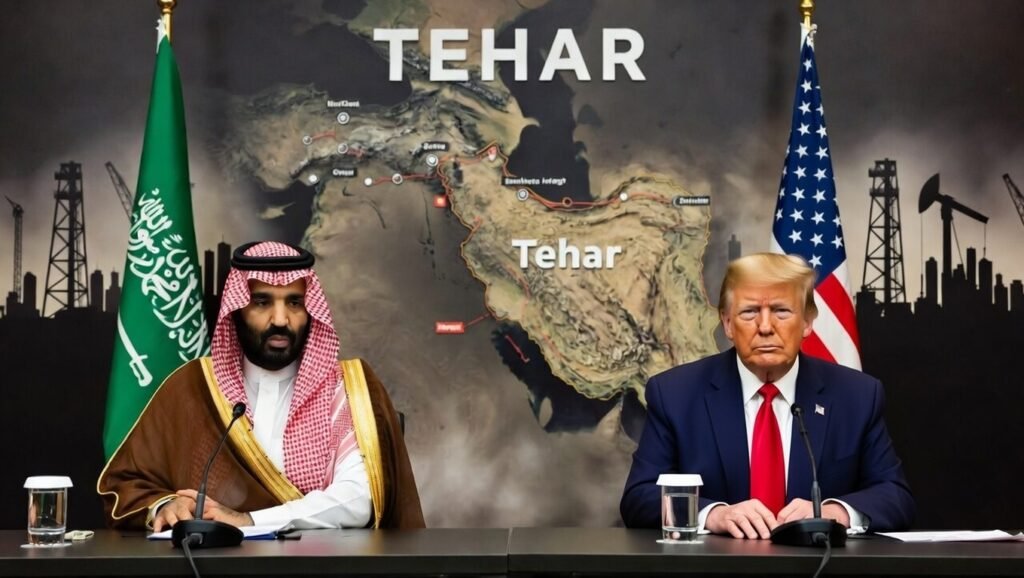
In the volatile landscape of Middle Eastern geopolitics, speculation has swirled about whether Saudi Arabia might retaliate against the United States if Washington launches military action against Iran, particularly targeting Tehran. Recent tensions, fueled by U.S. threats amid Iran’s internal unrest and nuclear concerns, have prompted Riyadh to clarify its position clearly and decisively—no, Saudi Arabia will not attack U.S. forces or interests, but it has taken steps to distance itself from any potential conflict.
The Kingdom has repeatedly emphasized its commitment to regional stability, especially following the 2023 rapprochement with Iran brokered by China. This détente marked a pragmatic shift, prioritizing economic diversification under Vision 2030 over prolonged proxy confrontations. In recent months, as U.S. President Donald Trump has signaled possible strikes in response to Tehran’s crackdown on widespread protests sparked by economic collapse, Saudi leaders have actively worked to prevent escalation.
Crown Prince Mohammed bin Salman conveyed a direct message to Iranian President Masoud Pezeshkian during a January 2026 phone call, reaffirming that Saudi Arabia would not permit its territory or airspace to be used for any military operations against Iran. This assurance was publicly echoed through official channels and reported by multiple sources close to the Saudi government. Riyadh’s foreign ministry has described potential U.S. actions as violations of sovereignty, urging restraint, de-escalation, and diplomatic solutions to avoid broader instability.
This position stems from several strategic calculations. First, Saudi Arabia fears Iranian retaliation against U.S. bases on its soil or in neighboring Gulf states, which could draw the Kingdom into unwanted conflict despite its non-involvement. Tehran has explicitly warned regional allies—including Saudi Arabia and the UAE—that American military installations would become targets in the event of a U.S. strike. Past incidents, such as the 2019 drone attacks on Saudi oil facilities attributed to Iran-backed Houthis, underscore these risks.
Second, a large-scale U.S. campaign—potentially aimed at regime change or crippling Iran’s nuclear remnants—could destabilize global oil markets, spike prices, and undermine Saudi economic goals. Gulf states, including Saudi Arabia, Oman, and Qatar, have privately lobbied Washington against aggressive action, warning that even limited strikes risk rallying Iranian hardliners and suppressing domestic dissent rather than weakening the regime.
While Saudi Arabia condemned previous U.S. strikes on Iranian nuclear sites in June 2025 as concerning violations, it stopped short of outright opposition to America, its key security partner. Riyadh’s statements focused on calls for de-escalation and political resolutions, reflecting a balanced approach: maintaining strong ties with the U.S. while preserving the fragile thaw with Iran.
Analysts note that Saudi Arabia’s neutrality in recent escalations—neither fully endorsing nor condemning U.S. moves—serves its quest for regional leadership without entanglement in another war. The Kingdom has engaged in back-channel diplomacy with Tehran, Qatar, Oman, and others to urge restraint from all sides.
In short, there is no credible evidence or official indication that Saudi Arabia would attack U.S. forces or interests over a strike on Iran or Tehran. Instead, Riyadh has prioritized self-preservation, economic stability, and diplomatic maneuvering to keep the powder keg from igniting further. As protests continue in Iran and U.S. carrier groups remain positioned nearby, the Kingdom’s message remains clear: stability benefits everyone, and escalation serves no one’s long-term interests. Whether this fragile balance holds will depend on decisions in Washington, Tehran, and beyond